Most Equipment Deals
Don't Fail at Sourcing.
They Fail at Execution.
Unreliable suppliers. Payments made with no structure behind them. Deliveries that disappear into silence. This guide exists because the gap between finding equipment and actually receiving it is where most buyers lose money, time, and leverage.
No call required. Delivered instantly to your inbox.
The Hidden Risks
Most Buyers Learn Too Late.
Buying industrial equipment looks straightforward on paper. Find the supplier. Make payment. Clear the goods. Deliver to site. This is where serious losses happen — not in the purchase, but in the execution. Each risk below represents a pattern, not a possibility.
Miscommunication on Specifications
A supplier states a machine weighs 8 tons. It weighs 12. The trailer cannot carry it. You now pay for a second truck and additional crane time — on a deal that was already agreed and paid. Specification errors are not rare. They are a standard outcome when there is no verification layer.
Fake Suppliers and Payment Risk
Professional-looking invoices and equipment photos are straightforward to produce. Without a structured verification process, buyers transfer large payments and discover the problem only when communication stops and the equipment does not arrive.
Delivery Damage From Poor Handling
Improper strapping, under-rated trailers, and incorrect loading angles damage hydraulics, axles, and structural components. Equipment that cleared correctly can arrive on site in a condition that voids its value. Supervision during loading is not optional — it is the last line of protection.
Hidden Transport Costs That Surface After Payment
Escort vehicles, oversize permits, crane hire, waiting charges, and rerouting costs are rarely disclosed clearly at the point of agreement. They appear after commitment has been made and the buyer has no remaining leverage to negotiate from.
Delays That Affect Everything Downstream
Traffic restrictions, bridge height limits, port congestion, and route disruptions are not edge cases — they are operational realities. When equipment delivery is attached to a project timeline, a delay in transit is a delay in everything that follows. Uncoordinated deliveries absorb this risk silently until it is too late.
The guide addresses each of these failure points directly — with the process, checklists, and structure that prevent them.
Six Sections.
Each One Practical.
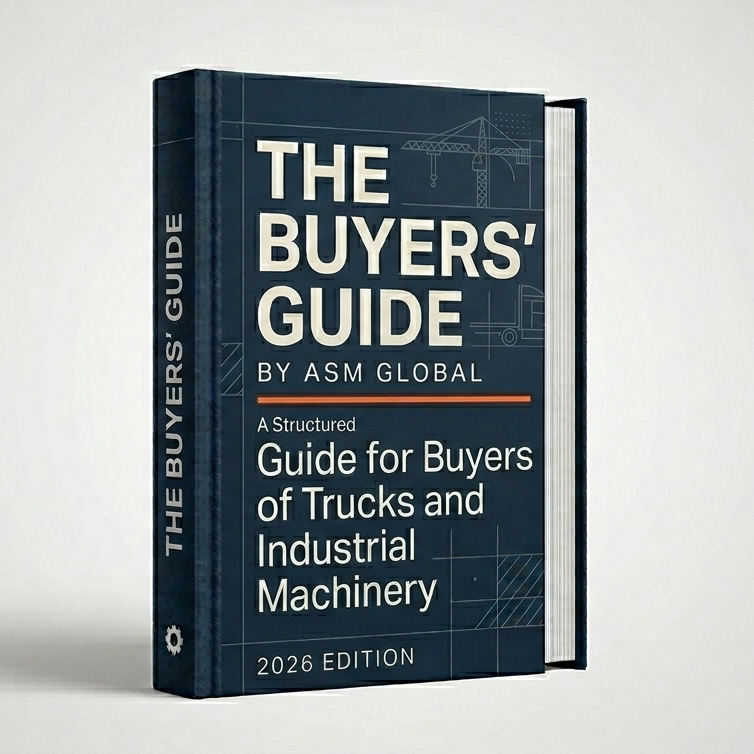
This is not a general overview. Every section addresses a specific failure point in the equipment sourcing and delivery process — drawn from how these deals actually go wrong. No theory. No filler.
The Hidden Risks in Equipment Sourcing
Miscommunication on weight and specs, fake suppliers, delivery damage, hidden transport costs, and delay patterns — each risk explained with the context buyers need to recognise it before it costs them.
Five Costly Mistakes Buyers Make
Choosing the cheapest truck. Assuming clearance ends the risk. Skipping weight verification. Leaving loading unsupervised. Ignoring insurance. Each mistake is documented with its real consequence.
What Happens After Clearance
Clearance is one stage. Movement is another risk layer entirely. The guide covers trailer selection, route assessment, loading balance, permit processing, and real-time tracking — the coordination work that most buyers overlook.
The Smart Buyer's Checklist
A practical, field-tested checklist covering physical verification, supplier checks, loading supervision, permit confirmation, insurance, documentation, and contingency planning — from pre-payment to site delivery.
A Real-World Coordination Failure
A contractor purchased a heavy excavator at a strong price. Transport was arranged without checking bridge height limits. The load was stopped mid-route. Rerouting caused significant delays and additional cost. The guide walks through exactly how this was avoidable.
How Professional Coordination Protects the Buyer
Verified capacity. Supervised loading. Careful route planning. Monitored delivery. The guide explains what structured coordination covers and why an experienced coordination layer consistently saves more than it costs.
All six sections. One document. No commitment required.
Mistakes in This Process
Have Real Business Consequences.
Industrial equipment is expensive. The margin for error in sourcing and delivery is narrow. The consequences below are not worst-case scenarios — they are the documented outcomes of decisions that look reasonable until they are not.
Choosing the cheapest transport option
Low pricing on haulage reflects low maintenance standards and rushed handling. Equipment damage in transit is not covered by the carrier. The buyer absorbs the cost.
Treating clearance as the finish line
Clearance is one stage. What follows — trailer selection, loading, routing, permits, site delivery — is where the majority of post-payment losses occur. The risk does not end at the port.
Accepting paper specifications without physical verification
Weight and dimension errors on supplier documentation are common. A 4-ton discrepancy means a second truck, crane time, and a delay that was entirely preventable. Verification costs almost nothing compared to the correction.
No supervision during loading
Drivers are not always familiar with the mechanical sensitivity of industrial equipment. Incorrect strapping angles and unsecured components cause structural damage that is invisible until the machine is put to work on site.
Skipping insurance because the deal looks clean
One transit incident — a rollover, a collision, a loading failure — can erase months of operating profit. Insurance is not a cost to avoid. It is the minimum floor of a serious procurement strategy.
An informed buyer protects profit. The guide gives you the information — before the decision, not after the loss.
Request Your Copy.
Delivered to Your Inbox.
Enter your email address. The guide is sent immediately — practical, direct, and written for buyers who need the process, not a sales pitch.
- Practical. Written for buyers, not consultants.
- Your details are handled with discretion.
- Produced by ASM Global LTD — a structured industrial trade coordination firm.